TL;DR
- The category is not solar company. It is who may legally pull the electrical permit in your municipality, since Illinois issues no statewide electrician licence and authority is municipal.
- Chicago rooftop systems at or below 13.44 kW inverter output take the Express or Easy Permit route, same-day approval at a $275 fee, filed by a licensed contractor.
- Verify three registries before signing: the City electrical contractor lookup, the ICC Distributed Generation Installer docket, and the Illinois Shines Approved Vendor and Program Violations lists.
- The 30% federal residential credit ended 31 December 2025. Illinois Shines pays roughly $80.77 per REC plus a $20 adder, with a $300 per kW utility rebate.
- Envelope and panel work usually precede modules. One Chicago retrofit measured 5,000 cubic feet per minute of leakage, equal to a 22-by-22-inch hole open year round.
- Repair beats replacement when the fault is one component. A thermal scan on a 100 kW site traced whole-array underperformance to a chipped cell and a misaligned bus bar.
Q1. What Are the 7 Best Solar and Energy Efficiency Installation, Repair and Service Contractors in Chicago in 2026? [toc=1. Chicago Solar Contractor Shortlist]
Highlights Chicago opens this shortlist because the work that gates a Chicago array is licensed electrical work: load calculation, service upgrade, conduit, rough-in, and final inspection. Also shortlisted: The Solar Soldier, Ailey Solar, Tesla Solar Chicago, Kaizan, FreeWorld Electric & Solar, and SLR Solar Panel Installer. Sort them by permit authority in your municipality, crew depth, and willingness to take a repair-only call.
⚠️ The real selection problem is not the panel brand
Most Chicago solar shopping starts with modules and price per watt. That is the wrong first question. The first question is who may lawfully pull the electrical permit at your address.
Illinois issues no state electrician licence. Every municipality licenses its own contractors, so a licence portfolio is a map, not a plaque. A service-area page proves marketing reach. Only a jurisdiction's registry proves permit authority.
Chicago adds a second filter. Rooftop systems with inverter output of 13.44 kW or less can use the Express or Easy Permit route, with same-day approval at a $275 fee, and the package must be filed by a licensed contractor in good standing. That filing sits with the same trade that handles a 100-amp to 200-amp service upgrade.
✅ How we weighted the criteria for this title
Seven criteria, weighted for solar installation, repair, and maintenance work.
- Municipal licence and registration (highest weight). This is the criterion that gates the permit, and therefore the job.
- Permit and inspection handling. Documented permitted work counts. A claim of experience does not.
- Electrical scope in-house. Solar on pre-war stock often needs a 100-amp to 200-amp service upgrade first, with meter, riser, and ComEd coordination.
- Repair and service after install. Inverter faults, underperforming optimizers, and detach-and-reset for a new roof all arrive years later.
- Verified review evidence. Platform, rating, and volume, always reported separately.
- Pricing transparency. Free estimate, disclosed site or diagnostic fee, and written scope before work begins.
- Service-area accuracy. Published coverage must match the registrations actually held.
💰 Who this shortlist is for
- You own a 1912 two-flat, the panel is full, and a solar quote just landed. That is usually a circuit breaker panel question before it is a solar question.
- You have a bungalow and want to know if 13.44 kW keeps you on the fast permit route.
- Your array has been underproducing since February and the original installer no longer answers.
- You are replacing a roof and need the panels off and back on without voiding a warranty.
- You are an income-eligible household checking whether Illinois Solar for All fits your building.
This is not for readers shopping for cash work with no permit, or for a roofer, plumber, or lead-generation platform.
⭐ The ten-second version
- Highlights Chicago: best for the permitted solar photovoltaic electrical scope behind and around the array.
- The Solar Soldier: best for a consultative first conversation, including being told no.
- Ailey Solar: best for a long-tenured installer with a standing service department.
- Tesla Solar Chicago: best for buyers already committed to the Tesla ecosystem.
- Kaizan: best for buyers who want the largest review volume outside the top row.
- FreeWorld Electric & Solar: best for combined electrical and solar scope on smaller jobs.
- SLR Solar Panel Installer: best for straightforward residential rooftop installs.
Want a second set of eyes before you sign? Ask any contractor on this list for their City licence number and the permit route they intend to file, then check it yourself in the City registry. Highlights Chicago gives free estimates and will hand over its licence number and insurance certificate before the contract, not after.
1.1 Highlights Chicago [toc=1.1 Highlights Chicago]
Overview. Highlights Chicago is an electrical contracting corporation at 5766 N Lincoln Ave, led by President Vesna Zuric, with named in-house crews including Boz, Raul, Ben, Jimmy, Andriy, and Kaplan.
Core services. Roughly 85 published services across eleven categories, including green energy, EV charging, inspections, power distribution, and lighting. It does not do plumbing, HVAC mechanical, or roofing.
🔌 What the permit record shows
Public permit records list 1,090 permitted projects, with 70 in 2023, 79 in 2024, and 85 in 2025. The four-year mix runs 165 electrical, 47 home additions, 9 new constructions, and 8 commercial renovations. BuildZoom places the firm at score 125, the 99th percentile of 65,686 Illinois licensed contractors.
Job sizes span the market: 54 permits under $5,000 and 10 above $1 million. Permit valuations reflect total project construction value, not any contractor's contract value.
Licence and coverage. Chicago ECC96456 and ECC94521, Evanston 18LICL-0250, and Palatine CON-006592-2024, all verified active in July 2026.
Key strengths. Metal raceway work to the City of Chicago Electrical Code. Service upgrades end to end, including meter, riser, service entrance, and ComEd coordination. Crews are salaried, so nobody presenting a diagnosis earns more for a bigger answer.
Who it fits. Owners whose solar plan runs through a panel, a riser, a violation, or an inspection.
Pricing approach. Free estimates on every job, free consultation on code-violation review, and a written scope with timeline and budget after assessment.
When to shortlist them. When the array requires a service upgrade, a grounding correction, or code violations cleared first.
When not to. If you want a single vendor to design, finance, and register the PV system with Illinois Shines, a dedicated solar Approved Vendor is the better fit.
🗣️ What customers say
"So when it came time to address significant code violations in preparation for installing solar panels, we went with Highlights again... All of this work was excellent and was permitted by the City without a hitch."
— Doug Ferguson, Highlights Chicago Google Verified Review
"ComEd would not do it until I got updated risers and weatherheads on my front house and my coach house... The best part was I didn't have to deal with ComEd at all."
— Kelly Luchtman, Highlights Chicago Google Verified Review
"We scheduled a site visit. But the company did not call or show up during our scheduled appt time. I had to reach them, to learn they needed to reschedule."
— Brian Ortiz, Highlights Chicago Google Verified Review
Google shows 4.9 across approximately 494 reviews, and Yelp approximately 290 reviews, reported separately.
Highlights Chicago earns row one here on one narrow, checkable claim: the registrations that close a permit in Chicago, Evanston, and Palatine, plus 1,090 permitted projects on public record, and a crew that still comes out for a two-hour repair job.
1.2 The Solar Soldier [toc=1.2 The Solar Soldier]
Overview. The Solar Soldier operates from 444 W Lake St Ste 1700 in Chicago and appears in the local pack for four solar keywords in this category.
Core services. Residential solar consultation and installation. Broader electrical scope is not publicly disclosed.
Licence and coverage. Not publicly disclosed. Verify against the City registry and the Illinois Shines Approved Vendor list before signing.
🧭 The strength: being told no
Reviewers repeatedly describe a consultative process, including cases where solar was not recommended.
"Our low electric bills didn't justify installing solar panels. Rather than try to talk us into an extremely long payback, Eric suggested we purchase our electricity from a solar company."
— Drdonna Feldman, The Solar Soldier Google Verified Review
"They educate their customer even if they don't do business with you they are 100 transparent."
— medricc Spencer, The Solar Soldier Google Verified Review
Google shows 5.0 across 19 reviews. That is a small sample, and a small sample tells you less than a large one.
Who it fits. Owners who want an early honest read on whether solar pays at their address.
Pricing approach. Not publicly disclosed.
When to shortlist them. For a first consultation before you commit money or a roof.
When not to. For a permit-heavy job needing documented volume, or for repair work on someone else's array.
Highlights Chicago takes the same posture on a different scope: the solar panel installation support work, meaning the panel upgrade or grounding correction, gets quoted only when the load calculation says it is needed, because salaried crews have nothing to gain from a larger recommendation.
1.3 Ailey Solar [toc=1.3 Ailey Solar]
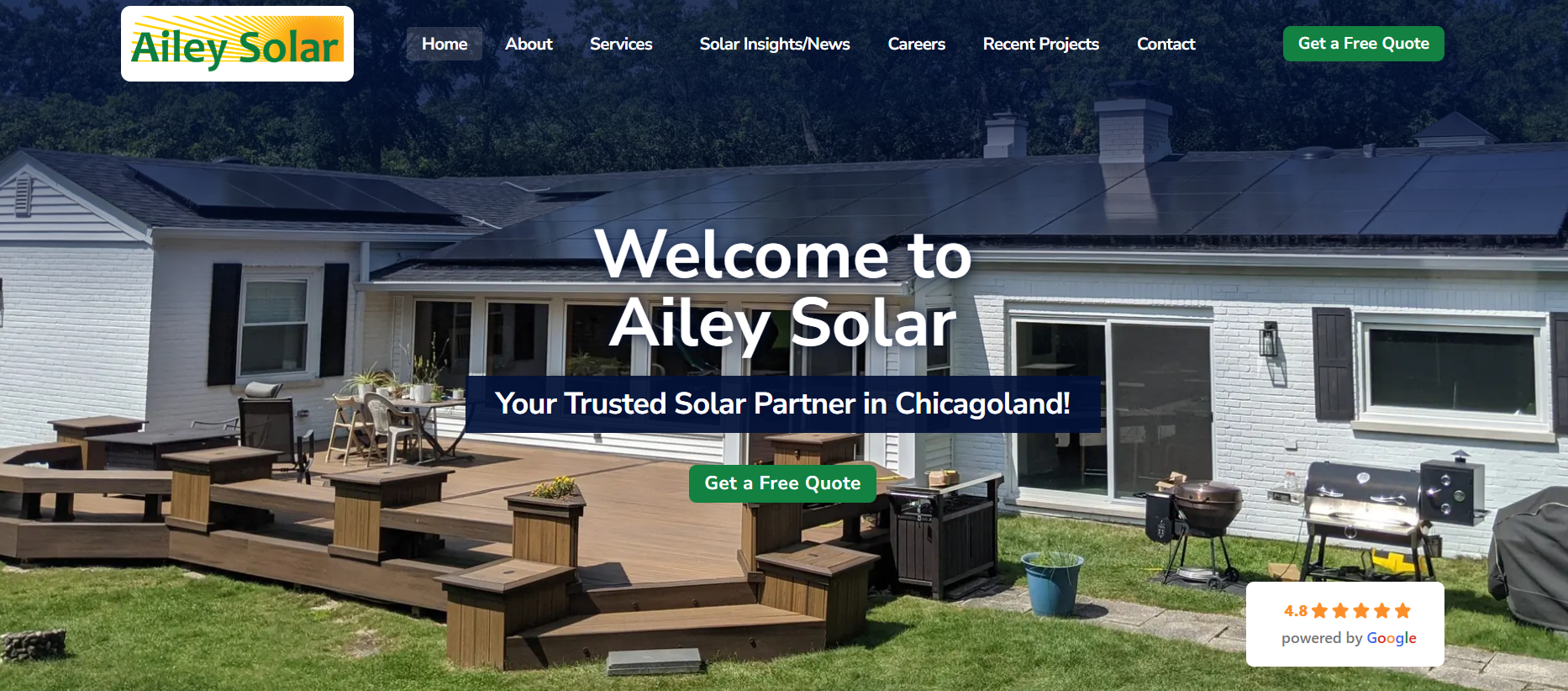
Overview. Ailey Solar Electric operates from 1965 W Pershing Rd in Chicago and appears in the local pack for three solar keywords in this category. Reviews stretch back roughly ten years, which is unusual in Illinois solar.
Core services. Residential and commercial rooftop and garage arrays, battery storage, energy audits, EV charging circuits, and post-install service. Roofing is referred out, not performed.
Licence and coverage. Not publicly disclosed in the review dataset. Reviewers describe permit work with the City of Chicago, the Village of Oak Park, and suburban offices. Verify the company against the City registry and the Illinois Shines Approved Vendor list yourself.
🔧 The strength is the service department
Longevity matters when a warranty claim lands in year eight. Reviewers name a service lead who returns for caulking, optimizer faults, and inverter boards. One buyer describes panels removed and reset in a day so roofers could work.
That covers two of the three repair families: monitoring and inverter faults, plus detach-and-reset.
Who it fits. Owners who want one company for the install and the next decade of service calls.
Pricing approach. One reviewer reports a $750 site-assessment fee inside a $2,500 deposit, with only $1,750 refunded after cancellation.
When to shortlist them. A residential array where post-install support and warranty follow-through matter most.
When not to. If you want no money committed before a site assessment, ask about that fee first.
🗣️ What customers say
"After about 2 years the inverter stopped working, all covered under warranty work and Ailey Solar Service department had it replaced quickly."
— Jason Rafkind, Ailey Solar Google Verified Review
"Ailey returned and removed all the panels so the roofers could work. Then, they replaced them the next day."
— Michael Mangis, Ailey Solar Google Verified Review
"So I was essentially charged 750 for a one hour visit... If you're thinking about Solar please protect yourself and negotiate a better contract than I did."
— Oscar Sanchez, Ailey Solar Google Verified Review
Google shows 4.8 across 63 reviews.
1.4 Tesla Solar Chicago [toc=1.4 Tesla Solar Chicago]
Overview. Tesla Solar Chicago is listed at 70 W Madison St in Chicago and ranks for two solar keywords in this category.
Core services. Solar energy equipment supply and installation within a single hardware ecosystem. Broader electrical scope is not publicly disclosed.
Licence and coverage. Not publicly disclosed. Chicago requires that the electrical permit package be filed by a licensed contractor in good standing, so ask who files yours.
⚡ One vendor, one app, one warranty path
Single-vendor buying has a real benefit. Hardware, monitoring, and warranty all sit with one party, so nobody argues about whose component failed.
The trade-off is flexibility. If your roof or panel needs work outside that product line, a separate electrical contractor usually enters the job anyway.
Who it fits. Buyers already committed to Tesla panels, inverters, and battery storage.
Pricing approach. Not publicly disclosed.
When to shortlist them. A standard rooftop array on a sound roof with a modern service panel, where you want one brand end to end.
When not to. A 1912 two-flat in Logan Square with a 100-amp fuse box. That job starts with a load calculation and a service upgrade, then the array.
⚠️ What to verify before signing
Google shows 5.0 across 11 reviews. Eleven reviews is a thin sample, and thin samples move fast in either direction.
Ask for the ICC Distributed Generation Installer docket number under 83 Ill. Adm. Code Part 468, plus the Approved Vendor status if Illinois Shines money is in the quote.
1.5 Kaizan [toc=1.5 Kaizan]
Overview. Kaizan appears in this solar and energy-efficiency cluster with the largest review volume on the list after row one.
Core services. Solar and energy-efficiency work. A full published catalogue is not publicly disclosed in the dataset reviewed here.
Licence and coverage. Not publicly disclosed. Confirm registration in your own municipality before any permit conversation, because Illinois has no statewide electrician licence.
📊 Volume is evidence, but only of consistency
A large review count tells you a company has done many jobs and kept most customers content. It does not tell you which jurisdictions it can pull permits in.
Those are separate questions, and only the second one decides whether your inspection happens on time.
Who it fits. Buyers who weigh sustained review volume heavily when shortlisting.
Pricing approach. Not publicly disclosed.
When to shortlist them. A straightforward residential efficiency or solar project where you want a well-reviewed operator and will verify credentials yourself.
When not to. A permit-heavy rehab running against a general contractor's rough-in date, unless the registration and crew depth check out first.
✅ The two documents to request
Google shows 4.9 across approximately 266 reviews. Ask for the City licence number and the intended permit route in writing.
Then look the number up yourself. A contractor who resists that request has answered the question for you.
1.6 FreeWorld Electric & Solar [toc=1.6 FreeWorld Electric and Solar]
Overview. FreeWorld Electric & Solar presents combined electrical and solar scope, which is uncommon on a solar shortlist.
Core services. Electrical work and solar installation. The published split between the two is not publicly disclosed.
Licence and coverage. Not publicly disclosed. Verify against the City of Chicago electrical contractor registry and the relevant suburban board.
🔌 Why combined scope matters on old stock
Solar on pre-war Chicago housing often stalls on the panel, not the roof. A firm that does both can size the array and the service in one visit.
That removes a handoff, and handoffs are where schedules slip.
Who it fits. Owners whose array needs modest electrical work alongside the install.
Pricing approach. Not publicly disclosed.
When to shortlist them. A smaller residential job needing both a circuit change and a modest array.
When not to. A large multifamily or commercial project, where documented permit volume and crew depth should decide the award.
💰 Ask how the quote is split
Google shows 4.8 across approximately 60 reviews. Ask for the electrical scope and the solar scope as separate line items.
A bundled per-watt price can hide a service upgrade the reader never agreed to buy.
1.7 SLR Solar Panel Installer [toc=1.7 SLR Solar Panel Installer]
Overview. SLR Solar Panel Installer is an install-focused operation in this Chicago solar cluster.
Core services. Residential solar panel installation. Repair, maintenance, and monitoring terms are not publicly disclosed.
Licence and coverage. Not publicly disclosed. Ask for the licence number, the issuing city, and the expiration date.
⏰ What an install-only shop means later
An install-first operation can be quick and clean on day one. The question is who answers in year six when an optimizer drops offline.
Ask, in writing, whether service calls are handled in-house or referred elsewhere.
Who it fits. Buyers with a sound roof, a modern panel, and a simple rooftop layout.
Pricing approach. Not publicly disclosed.
When to shortlist them. A conventional array where you want a focused installer and hold your own service plan.
When not to. A repair-only call on an array installed by someone else.
Google shows 5.0 across approximately 59 reviews.
How we evaluated this shortlist [toc=1.8 How We Evaluated]
Sources checked: the City of Chicago Department of Buildings licence pages and the Electrical Contractors registry, the City's solar permitting guidelines and Express Permit instructions, ComEd net metering and interconnection documents, Illinois Power Agency and Illinois Shines programme records, and Google review datasets held in this project.
Excluded: lead-generation platforms, which never perform the work, and any figure sourced only from a company's own marketing.
Not verified: licence numbers for six of the seven providers, which is why those cells read "Not publicly disclosed" rather than carrying a guess.
One accounting note. Permit valuations reflect total project construction value, not any contractor's contract value.
Which provider should you shortlist? [toc=1.9 Which To Shortlist]
- Permitted rehab in Chicago with a rough-in date: shortlist Highlights Chicago, then a dedicated solar Approved Vendor for the array itself. Ask about the electrical installation sequence before the array is ordered.
- 100-amp fuse box that must become 200 amps before panels: shortlist Highlights Chicago and confirm ComEd scheduling in the quote. A fuse box to breaker conversion is the first line item.
- Array underperforming since February: shortlist Ailey Solar for its standing service team, and ask for a thermal scan before any module swap.
- Roof replacement with existing panels: shortlist Ailey Solar or any firm that quotes detach-and-reset as a named line item.
- First conversation, still unsure solar pays: shortlist The Solar Soldier, whose reviewers describe being told the payback did not work.
- Tesla ecosystem buyer with a modern panel: shortlist Tesla Solar Chicago, and verify who files the permit.
- Income-eligible household at or below 80% of area median income: check the Illinois Solar for All lookup first, then shortlist an Approved Vendor. An energy audit tells you whether the building is solar ready.
- Violation notice blocking a closing: shortlist Highlights Chicago, since the correction is code violation correction work with an inspection attached.
Highlights Chicago holds Chicago licences ECC96456 and ECC94521, Evanston 18LICL-0250, and Palatine CON-006592-2024, all verified active in July 2026, alongside 1,090 permitted projects on public record. Vesna Zuric, President, treats the two-hour call and the 56-unit build as the same trade, and we would rather you check those numbers than take them on trust. Book a free on-site assessment when the array plan touches the panel, browse the full list of electrical services, or read the panel upgrade explainer and the customer testimonials first.
Q2. What Has to Happen Before the Panels: Envelope, Load Calculation and Service Upgrade? [toc=2. Before The Array]
Three things usually come before modules on a Chicago roof: an envelope fix, a load calculation, and often a 100-amp-to-200-amp service upgrade with a new meter and riser coordinated with ComEd. One Chicago retrofit measured 5,000 cubic feet per minute of leakage at 50 pascals, the equivalent of a 22-by-22-inch hole open year round.
⚠️ Most quotes start at the roof, and that order is backwards
You have a solar proposal with a panel count and a per-watt price. You do not have a blower door number, which is the measured air leakage of your building.
That means the array was sized against your old bill, not your real load. Sizing against a leaky building buys generation you keep losing through the walls.
A "load calculation" is simply the math that adds up what your home actually draws. It decides the array, not the square footage of your roof.
🏚️ The colander problem in pre-1945 stock
One deep retrofit of a Chicago building found leakage of roughly 5,000 cubic feet per minute at 50 pascals of depressurization. That is a 22-inch square hole, permanently open.
The owner's own conclusion was blunt. It was the envelope work that produced the load reduction, and the rooftop array only reached net zero afterwards.
The retrofit budget ran near $220,000, and afterwards, the measured electricity cost per apartment came in far below the Illinois average. Highlights Chicago runs the load calculation and the service upgrade assessment before anyone sizes an array, because that sequence is what the inspection and the utility both assume.
🔌 The prerequisite nobody puts in the solar quote
Solar on a 1912 two-flat in Logan Square often stalls at the panel. A 100-amp fuse box or an obsolete panel has to become a 200-amp service first, with meter, riser, and service entrance.
Illinois Solar for All will not approve a home that is not "solar ready," which includes roof condition, a modern panel, and low shading. That single requirement kills more projects than shading does.
"We contacted Safe Electrical for the upgrade needed for our solar panels installation this summer... Charles and his team returned to tweak our new system as required by subsequent city and ComEd inspections."
— mary kenny, SAFE Electrical Service Google Verified Review
"During an inspection for our home remodel we discovered our electrical panel wasn't properly grounded according to current code... We've been very pleased with their work and we passed the new electrical inspection."
— Beth Spargo, Highlights Chicago Google Verified Review
✅ The Monday sequence
- Book a blower door test and get the number in writing.
- Air seal and insulate against that number, then re-test.
- Get a load calculation on the reduced load.
- Confirm whether the service panel supports the array before you sign for modules.
I will hedge one part of this. Envelope-first is right for most pre-war buildings, though a 2005 build with a modern 200-amp panel can reasonably skip straight to the array.
Highlights Chicago will tell an owner to spend the first dollars on the service panel and the envelope rather than on extra modules, because that is the order the permit, the inspector, and ComEd all expect. An energy audit is where that conversation starts.
Q3. Which Chicago Permit Route Applies, and How Long Until ComEd Lets the System Run? [toc=3. Permits And Interconnection]
Every rooftop solar system in Chicago needs an electrical permit. Systems with inverter output of 13.44 kW or less qualify for the Express or Easy Permit Process, with same-day approval at a $275 fee and storage up to 20 kWh. Larger or structurally complex jobs go to Standard Plan Review. ComEd's countersignature after the witness test is permission to operate.
📋 Two routes, one number that decides which
The dividing line is inverter output, measured in kilowatts (kW), not panel count. At or below 13.44 kW, the job takes the fast route, and the fee drops from $375 to $275.
Above that, or where structural work is involved, the job goes to Standard Plan Review. That path runs closer to 30 days than one day, and it changes your whole schedule.
Battery storage is allowed on the fast route up to 20 kWh, with a lower cap for some battery chemistries.
🏠 Which route your building probably takes
The permit package must be filed by a licensed contractor in good standing, not by you. That single rule is why the licence question comes before the price question. The same rule governs commercial electrical work on a small retail or office unit.
⏰ The seven steps to permission to operate
- File the Level 1 interconnection application with ComEd, including the fee.
- ComEd confirms the application is complete.
- Conditional approval arrives.
- Install the system and pass the local electrical inspection.
- Submit the Certificate of Completion.
- The meter is verified or exchanged.
- Pass the witness test, then ComEd countersigns. That signature is permission to operate.
Panels on the roof are not a working system. Systems energised on or after 1 January 2025, also receive supply-only net metering credits, priced at 10.399 cents per kWh as of 1 June 2026.
💸 What a failed inspection actually costs
A failed rough-in or final does not cost hours. It costs weeks, because you rejoin an inspection queue and your other trades keep moving without you.
Chicago also has spacing rules that surprise owners on tight lots, including fire-rated separation where a neighbouring building sits close. Ignore anyone marketing a same-day solar install, because code compliance and utility scheduling do not compress.
Three lines to demand in the contract. Who files the interconnection application, who schedules the witness test, and who pays if a re-inspection is needed.
Highlights Chicago names the permit route in the proposal and puts the rough-in and final inspection dates on the schedule before the crew arrives, because a failed final on a two-flat costs weeks, not hours. Where a notice is already open, the code violation correction comes first.
Q4. How Do You Verify a Solar Contractor Is Licensed and Will Actually Work at Your Address? [toc=4. Licence And Coverage Check]
Check three registries, never the company website: the City of Chicago electrical contractor lookup for licence number and expiration, the ICC Distributed Generation Installer certification docket under 83 Ill. Adm. Code Part 468, and the Illinois Shines Approved Vendor and Program Violations lists. Illinois issues no statewide electrician licence, so authority is municipal, and a service-area map is marketing, not registration.
🔍 The three checks, in order
- City licence. Search the Chicago Electrical Contractors registry for the company name. A pass shows a licence number and a future expiration date.
- ICC certification. Ask for the Distributed Generation Installer docket number. There is no public roster, so the number is the check.
- Illinois Shines. Confirm Approved Vendor or Designee status, and confirm the firm is absent from the Program Violations report.
Highlights Chicago holds Chicago ECC96456 and ECC94521, Evanston 18LICL-0250, and Palatine CON-006592-2024, and we would rather you look those up than believe us. The company background page lists the same registrations.
⚠️ What NABCEP does and does not prove
NABCEP is a voluntary certification, and it certifies individual people, not companies. It is a good sign about a technician's training.
It is not permit authority. Only the municipality that issues the licence can tell you who may pull a permit at your address.
🧭 The zip code that was not in the service area
One North Lawndale owner on the West Side kept hitting the same wall. The zip codes immediately east and west were inside company service areas, and theirs was not.
That is crew logistics and ticket economics, not capability. The fix was counterintuitive: search outward, because contractors based outside the usual rings will travel in.
Ask Highlights Chicago, or any contractor, to confirm registration in the exact municipality where the property sits, then check the answer against that jurisdiction's own registry. That check matters as much for a residential electrical job as for a rehab.
🗣️ What customers say about coverage and paperwork
"The team provided the required certificate of liability insurance on the same day I requested, I got the project approved by my building's association and had the installation scheduled."
— Marcel, Highlights Chicago Google Verified Review
"I had my solar system installed by an installer that went bankrupt. I contacted a few installers to see if they could help me out. They did not return my phone call. Ailey did return my phone call."
— Nathaniel Stott, Ailey Solar Google Verified Review
Google shows Highlights Chicago at 4.9 across approximately 494 reviews, with Yelp at approximately 290 reviews, reported separately. Ailey Solar shows Google 4.8 across 63 reviews.
✅ The pre-signature packet to request
Ask for four documents together: the City licence number, the ICC docket number, the certificate of insurance, and the written scope. A firm that supplies all four in a day is showing you how it will behave later.
Highlights Chicago hands over its City licence number and insurance certificate before the contract, and still sends someone out for a two-hour job on a West Side address. Ask for a free written estimate, or read the electrical terms glossary before the first call.
Q5. What Does Solar Cost in Chicago in 2026, and Which Incentives Still Pay? [toc=5. Cost And Incentives]
The 30% federal residential credit ended 31 December 2025. Illinois incentives rose instead: Illinois Shines pays about $80.77 per REC in ComEd territory at or below 10 kW plus a $20 customer-owned adder, and utilities pay a $300 per kW smart-inverter rebate direct to the owner. Expect roughly $22,000 to $28,000 installed for 8 kW before incentives.
💰 The 2026 stack, and who actually receives each dollar
A REC is a renewable energy credit, which is the paperwork value of the power your array produces.
The 2026 to 2027 Illinois Shines programme year opened on 1 June 2026 with 1,000 MW across six project categories.
⚠️ Two numbers that make old quotes wrong
Any proposal still showing a 30% federal credit line is stale. That line is now zero, and it was often the largest single item in a 2025 payback model.
Net metering changed too. Systems energised on or after 1 January 2025, receive supply-only credits, priced at 10.399 cents per kWh as of 1 June 2026.
One widely shared payback figure of 6.4 years came from a solar-plus-battery system outside Illinois. Your local number depends entirely on the stack above, so treat that figure as a comparison anchor, not a forecast.
🏠 The income-eligible route most quotes skip
Illinois Solar for All serves households at or below 80% of area median income. In Cook County, a household of four qualifies at $97,200 under thresholds effective 1 June 2026.
The programme caps savings at 50% of the energy value and requires the home to be solar ready. That means roof condition, a modern panel, and low shading. A green energy assessment tells you which of the three is blocking approval.
✅ Three lines to demand on every quote
- Which party receives the REC value, and how it appears as a discount.
- Who the $300 per kW rebate is paid to, by name.
- Net cost after both, with the electrical scope priced separately.
Highlights Chicago itemises the electrical scope, meaning panel, riser, conduit, and disconnect, as its own line, so the incentive math is not covering for a service upgrade nobody named. The riser and service entrance work is priced as its own item.
Q6. When Does Solar Repair Beat Replacement, and What Does Maintenance Really Involve? [toc=6. Repair Versus Replacement]
Repair wins when the fault is one component, a failed inverter, a crooked bus bar, a chipped cell, or a loose connection. Replacement wins when micro-cracking spreads across modules. Diagnose before buying anything. A thermal scan on one 100 kW site traced whole-array underperformance to a chipped cell and a bus bar touching its neighbour.
🔧 Three fault families, three different calls
Highlights Chicago takes the diagnostic call on arrays it did not install, which is what separates a repair invoice from a second full purchase. That work sits inside electrical troubleshooting rather than a sales visit.
🔬 What a thermal scan found on a 100 kW site
Production sat at only 100 to 125 units when it should have been far higher. Cleaning lifted it to 170, which still was not right.
The real causes were physical and tiny: a chipped piece of one solar cell, plus a bus bar installed crookedly and touching a neighbouring cell. Nobody would have found either by guessing.
Modern panels make this more common. Wafer thickness has fallen from roughly 250 to 300 microns to about 130 to 150, so micro-cracks are now the dominant failure mode. Loose or mismatched electrical connections matter too, with some measured failure rates running many times higher than properly made copper joints.
❄️ The blizzard call every installer gets
An owner phoned during a major winter storm, furious that a $30,000 array produced nothing. Two feet of snow sat on the roof, and the house had no backup power.
Both facts were normal. Snow stops production, and a grid-tied array without a battery goes dark in an outage. Owners who want power during an outage usually end up looking at standby generators instead.
Spiky loads add a second surprise. A battery inverter cannot follow a sudden surge fast enough, so a little grid power covers it even on a sunny day.
🗣️ What customers say about service calls
"AJ came out to see what was the problem with solar not communicating with app. Turns out the inverter board wasn't working. He replaced the board was able to get everything connected."
— Elizabeth Velez, Ailey Solar Google Verified Review
"After about 2 years the inverter stopped working, all covered under warranty work... Only small issue is I lost all my previous generation data."
— Jason Rafkind, Ailey Solar Google Verified Review
"Gig was the technician on site... He was able to quickly assess the issue, explain the issue in laymen's terms and correct it the same day."
— DiCostanzo, Highlights Chicago Google Verified Review
Ailey Solar shows Google 4.8 across 63 reviews. Highlights Chicago shows Google 4.9 across approximately 494 reviews, with Yelp at approximately 290.
✅ Before you authorise any module swap
Request the EL test report, short for electroluminescence, which makes micro-cracks visible. Every manufacturer runs it, and you simply have to ask.
Then ask for a thermal scan, and confirm which entity honours the workmanship warranty versus the product warranty. Those are usually two different companies.
Highlights Chicago measures the electrical side of a fault first, at the panel and the disconnect, because a dead array is sometimes a dead circuit rather than dead modules. A circuit breaker check costs less than a module order.
Q7. What Should You Ask Before You Sign a Chicago Solar Contract? [toc=7. Questions Before Signing]
Ask nine things and require a document for each: City licence number, ICC certification docket, Approved Vendor status, permit route, who files the interconnection application, panel EL test reports, the load calculation, whether a service upgrade is included, and the workmanship warranty term with the entity that honours it.
✅ The nine questions and the proof for each
- City licence number, with expiration date. Proof: the Chicago electrical contractor registry.
- ICC Distributed Generation Installer docket. Proof: the docket number itself.
- Illinois Shines status. Proof: the Approved Vendor and Program Violations lists.
- Permit route. Proof: the written proposal naming Express, Easy Permit, or Standard Plan Review.
- Interconnection filing. Proof: a named party in the contract.
- Panel EL test reports. Proof: the manufacturer's report per panel.
- Load calculation. Proof: the calculation sheet, not a verbal estimate.
- Service upgrade included or excluded. Proof: a separate priced line.
- Workmanship warranty term and who honours it. Proof: the warranty document.
❌ Two answers that should end the conversation
If a contractor says the job does not need a permit, stop. Every rooftop system in Chicago requires an electrical permit, and the filing must come from a licensed contractor in good standing.
If the answer is cash only with no certificate of insurance, stop again. Highlights Chicago would rather lose a bid on price than win one that skips the permit, because an unpermitted array becomes the owner's problem at a closing table years later. Cleared paperwork is the point of code violation correction work.
⏰ The order to run this week
Look up the licence first, because it decides whether the rest matters. Then request the ICC docket and the Approved Vendor status in the same email.
Book the site visit last, once the paperwork checks out. Free estimates cost you nothing, and by then you know who you are meeting.
Here is what I keep turning over. The registries have always been public, and homeowners are only now learning to open them, which quietly changes who wins bids in this city.
At the same time, EV chargers, heat pumps, and induction ranges are pushing 1912 two-flats in Logan Square and bungalows in Portage Park toward 200-amp service faster than the pre-war stock was ever meant to move. Highlights Chicago's permit record shows 85 permitted projects in 2025, and I read that as demand for service capacity rather than demand for panels, though I may be weighting it too heavily. The pressure shows up first as EV charging station requests, then as panel work.
If you have a quote in hand, send the licence number and the permit route, and tell us what the array is meant to cover. That conversation is usually shorter and cheaper than the one that starts after a failed inspection. Start with a free estimate request, or read the panel upgrade guide first.
Disclaimer: The information provided in this article is for general informational and educational purposes only and is not intended as professional electrical, engineering, safety, or legal advice. Electrical work can be dangerous and may result in serious injury, death, fire, or property damage if performed improperly. Readers should not attempt electrical work based solely on information contained on this website and should consult a qualified, licensed professional before performing or authorizing electrical work.
Highlight Chicago makes no representations or warranties regarding the completeness, accuracy, applicability, or currentness of the information provided. Electrical codes, permitting requirements, equipment specifications, and recommended practices may vary by location and change over time.
To the fullest extent permitted by applicable law, Highlight Chicago and its owners, employees, contractors, affiliates, and content providers disclaim liability for any loss, injury, damage, claim, or expense arising from or related to the use of, reliance upon, or actions taken based on information contained on this website. Use of this website and reliance on its content is at the reader's own risk.
FAQ's
Do you need a permit for solar panels in Chicago, and which route applies?
Yes. Every rooftop solar system in Chicago requires an electrical permit, and the filing has to come from a licensed contractor in good standing, not from the property owner.
The dividing line is inverter output, measured in kilowatts, not panel count:
- At or below 13.44 kW: the Express or Easy Permit route, same-day approval, $275 fee, with battery storage allowed up to 20 kWh and a lower cap for some battery chemistries.
- Above 13.44 kW, ground mounts, or structural work: Standard Plan Review, closer to 30 days than one day, at a $375 fee.
A bungalow with an 8 kW array almost always takes the fast route. A gut rehab or a ground mount does not, and that single difference reshapes the whole build schedule.
Highlights Chicago files under Chicago Electrical Contractor licences ECC96456 and ECC94521, both verified active in July 2026, and we name the intended permit route in the proposal before any crew is scheduled. Ask any bidder to do the same, then request the permit number once it issues.
If a contractor tells you the job needs no permit, treat that as the end of the conversation. Unpermitted work resurfaces at a closing table or an insurance claim years later, which is exactly what our permitted electrical installation work is structured to avoid.
How do you verify that a Chicago solar contractor is actually licensed?
Check three registries, and never the company website. Illinois issues no statewide electrician licence, so every municipality licenses its own contractors, and only a firm registered in that jurisdiction may pull a permit there.
- City of Chicago electrical contractor lookup. A pass shows a licence number and a future expiration date.
- ICC Distributed Generation Installer certification. Ask for the docket number under 83 Ill. Adm. Code Part 468. There is no public roster, so the number itself is the check.
- Illinois Shines. Confirm Approved Vendor or Designee status, and confirm the firm is absent from the Program Violations report.
NABCEP certification is voluntary and certifies individual technicians rather than companies. It says something useful about training. It says nothing about permit authority.
A service-area map is marketing, not registration. Highlights Chicago holds Chicago ECC96456 and ECC94521, Evanston 18LICL-0250, and Palatine CON-006592-2024, all verified active in July 2026, and we hand over the licence number and the certificate of insurance before the contract rather than after.
Request four documents in one email: licence number, ICC docket, insurance certificate, and written scope. Our electrical safety guidance covers why each one matters.
Do you need a 200-amp service upgrade before installing solar panels?
Three things typically come before modules on the roof:
- An envelope fix. One deep Chicago retrofit measured roughly 5,000 cubic feet per minute of leakage at 50 pascals, the equivalent of a 22-by-22-inch hole open year round.
- A load calculation. This is the math that adds up what the building actually draws. It decides the array size, not the square footage of the roof.
- The service panel itself. Illinois Solar for All will not approve a home that is not solar ready, which covers roof condition, a modern panel, and low shading.
Sizing an array against a pre-retrofit bill oversizes both the system and the invoice. Highlights Chicago runs the load calculation and the service assessment before anyone specifies modules, because that is the order the permit, the inspector, and the utility all assume.
On a 1912 two-flat, the first dollars usually belong in the panel. Our solar photovoltaic electrical work starts there.
When does solar panel repair make more sense than replacing the panels?
Repair wins when the fault is a single component. Replacement only wins when micro-cracking has spread across multiple modules, and that call should follow a measurement rather than a guess.
Chicago solar faults sort into three families:
- Inverter or monitoring faults. Check the app, then the inverter board. Usually a component swap, often under warranty.
- Storm or wildlife damage. Visual inspection first, then a thermal scan, then a targeted module or wiring repair.
- Roof replacement. A detach-and-reset quote: panels off, roof done, panels back.
The measurement matters. On one 100 kW site, production sat at 100 to 125 units, and cleaning only lifted it to 170. Thermal scanning traced the real cause to a chipped piece of one solar cell plus a bus bar installed crookedly against its neighbour.
Before authorising any module swap, request the EL test report, short for electroluminescence, which makes micro-cracks visible. Every manufacturer runs it, and you simply have to ask.
Highlights Chicago measures the electrical side of a fault first, at the panel and the disconnect, because a dead array is sometimes a dead circuit. That is electrical troubleshooting work, and we take the call on systems we did not install.
What solar incentives still pay in Illinois in 2026, and who receives the money?
The 30% federal residential credit ended on 31 December 2025, so any quote still showing that line is stale. Illinois incentives rose instead, and the 2026 to 2027 Illinois Shines programme year opened on 1 June 2026 with 1,000 MW across six project categories.
What pays now, and to whom:
- Illinois Shines REC payment: about $80.77 per REC in ComEd territory at or below 10 kW, received by the Approved Vendor and usually passed through as a discount.
- Customer-owned adder: $20 per REC, reaching the owner via the vendor.
- Smart-inverter rebate: $300 per kW, paid by the utility directly to the owner.
- Illinois Solar for All: for households at or below 80% of area median income, with a Cook County household of four qualifying at $97,200 under thresholds effective 1 June 2026.
Net metering also changed. Systems energised on or after 1 January 2025 receive supply-only credits, priced at 10.399 cents per kWh as of 1 June 2026.
Demand three lines on every quote: who receives the REC value, who the rebate is paid to by name, and the net cost after both. Highlights Chicago itemises the panel, riser, conduit, and disconnect as separate lines, so the incentive math never hides a service upgrade. See our solar panel installation support scope.